Showing posts with label pacifism. Show all posts

Saturday, May 19, 2012

417. Military Chaplaincy, Pt. 35 (Davies, pt. 1)

This next article is:

Davies, Richard E. (1978, Spring). Relations between the early church and the Roman military establishment. Miliary Chaplains' Review. 23-34.

***
"So there were Christian soldiers, in spite of the fact that the military was the strong supporter of Mithra, one of the serious contestants with Christianity in the Roman religious arena. But even through there were Christian soldiers, there was a great deal of ambivalence about whether or not a Christian had the moral right to serve in the Roman army." (p. 24)

***

"The flamboyant Tertullian (c. 130-c. 220) and the ascetic Origen (c. 185-c. 254) had more to say about the military than any of the other Christian writers before the time of Constantine.  Both of them argued that Christians should not serve in the military, while arguing at the same time that Christians should support the military with prayers.   But if a Christian should not be a soldier, why not?

Cadoux demonstrates clearly that Origen held the pacifist positioin, saying that Christians should not fight.  Other issues such as idolotry within the army and common immorality among soldiers were not  particularly important for Origen.  But Origen seems to stumble into ambivalence at the point of supporting the state.  He stressed the positive contributions made to the state through intercessory prayers and through the influence on society of Christian education and the superior moral example of Christians.

Origen May have taken the clearest and, to modern ears, the most defensible position against Christian involvement with the military establishment, but if he had such a horror of war as Cadoux would claim, how would he pray for the success of pagan (Roman) armies? Origen recognized that the legions were necessary to the life of the empire, and he was not whole-heartedly ready to exchange the civilized empire for a barbaric chaos, regardless of his opinion of the army." (p. 28)

***

I was out all afternoon and evening, so I just wanted to get one article in and this is an easier one.  These texts just show that there is some history for pacifism in the church.  Not that it's conclusive or that it's the last word on it; but that it does have a long history.  Just something to think about and not to out of hand completely disregard views of Christians who chose to not support violence and war, who chose to put more emphasis on finding peaceful resolutions - more emphasis than is currently done.

I have come to espouse such a position.

Friday, May 11, 2012

398. Military Chaplaincy, Pt. 16 (Pendergraff, pt. 1)

This next article is:

Pendergraff, Isaac B. (1976, Winter). Ministry to conscientious objectors. Military Chaplains Review, pp. 38-45.

***
"Generally the issue of conscientious objection rises before one enters the service.  Once a person enters the military service, however, his or her application for conscientious objector status usually creates difficulties, if not serious problems. It is military policy to refuse to grant conscientious objector status based on conscientious objection which existed but was not claimed prior to military entry.  Military policy and procedure place considerable obstacles in the way of a person whose objections have developed after entering military service.  Moreover, the movement toward all-volunteer armed forces has not mitigated the problem of conscientious objection within the military.  A proposal was offered to abolish conscientious objection within the military due to the termination of the Selective Service System in 1973. Although the Department of the Army rejected the elimination of conscientious objector status, there is the strong presumption that a volunteer for military service would not be a conscietious objector.  This presumption, however, does not give due recognition to developmental conscientous objection.  Since human beings are dynamic rather than static, it is possible for a person who volunteers for military duty to develop into a conscientious objector." (p. 38)

I didn't have this underlined as one of the sections of text I was going to use, but I thought it was necessary as a background for the article and also a good discussion piece. (I've also studied more about pacifism since having done this research.)

So the issue first of all here is that there are people who disagree with what the army does, even after they have entered the army of their own free will.  If people could just see what the Vienna mission was like in secrecy, what it was capable of in how it treated me, maybe they could see me as sort of like a conscientious objector to the Vienna mission.  It's not an exact match, but maybe you can see what I mean. 

When I entered the mission, I didn't have anything against the mission - just like the conscientious objector who wasn't one when he entered the Army, but grew to be one during his experience in the Army.  My experience in the mission made me averse not to the basic things the mission stood for, but the secretive things it did and the things it did, presumably to protect itself from me.  But what had I done?  Had I done anything so horrendous?  Please tell me?  No!  I had done the crime of having a father in Boeing SDI management (1) and perhaps I was more independent than the mission or my father liked (2).  But what was I doing?  Attending an Austrian church comprised of about 30 Austrians and run by a well-known mission, 2) welcoming a friend and her bevel of junior high German students and another mission worker helped entertain for a couple days (so he actually could have been viewed as a possible monitor for me).  Are these things so awful?  Are my crimes so heinous?  So the thing was that their actions towards me, even before I had a chance to do anything, heinous or otherwise, was enough to make me become the Vienna mission equivalent of a conscientious objector.  Except I kept it to myself for all those millions of reasons I've discussed elsewhere on this blog. 

But the military chaplain had to deal with these things.  How would the Vienna mission chaplain/H.R. Director have responded to my "conscientious objection." He would most definitely not have provided me any leniency at all, based on how they treated me.   In any case, the military chaplian/H.R. director would NOT be writing an article in an East European mission journal about providing ministry to "conscientious objectors."  Instead, he'd be co-authoring an article with the director on how to get rid of such blights on the ministry (if not humanity). 

***
"The  prescribed methods by which the chaplain establishes the genuineness of a claim have certain shortcomings.  Military regulations require that the soldier be interviewed by a chaplain.  The chaplain could form his opinion solely on the basis of one interview rather than seeking additional information...

Additional instruments for gathering information must be used if the chaplain is to be persuasive... Thus, I recommend strategies of Rogerian Listenning, Either-Or Forced Choice, and Strength of Values. These strategies would assist the chaplain in offering evidence implicating the soldier's sincerity, his consistency, and the depty of his convictions.  Moreover, the strategies are non-clinical." (p. 41)
The chaplain writing this seems to me to have great integrity in wanting to even be involved this way in the process.  It's very difficult for me to picture the military chaplains in the Vienna mission ever doing this kind of thing.

***
"A chaplain's opinion establishing the sincerity of a soldier's claim may be rejected. If this occurs, the chaplain can then assume the role of a mediator...

The mediator must inform those who judge the merits of a soldier's claim that freedom of choice must be preserved... It is essential that the mediator be acquainted with the literature relating to the specific objection.

...The chaplain, as a mediator, does not seek to bring the soldier and the military bureaucracy to agreement on all issues, but rather to bring the two parties to mutual acceptance of differences." (p. 41)
So the chaplain must also serve a mediator role, which would be a whole different skill he'd be called upon to use, not to mention all the conscientious objection literature he'd have to acquaint himself with.  I don't suppose reserve chaplains would have to get involved with this kind of thing though, unless, of course, they were at some point not reserve but full-time chaplains.  I'm sure that this is not an easy role to take, considering the chaplain is up against such a militant army.  I can sure relate to that, though.  But the conscientious objector was fortunate to have a mediator.

***
"One problem which the chaplain faces as mediator is the ethos of the military bureaucracy.  The obedience principle of the military bureaucracy exerts a strong influence on mediation.  The obedience principle is characterized by tthe performance of what is required or enjoyed by authority. The opposite of compliance with authority is disobedience.  Both Levy and Noyd were caught between the military value of obedience and non-military values.  Both chose to vollow the dictates of their own conscience." (p. 42)
First off, I should note that the Levy and Noyd comments refer to illustrations at the beginning of the article about instances when military medical staff became conscience objectors and what happened to them. 

So the thing is that a mediator is mediating between compliance and disobedience and the chaplain is part of the military bureaucracy where this strong exertion is felt.  It's like being blind to one's own biases.  Researchers face it all the time.  And you think that science is unbiased and neutral?  Think again!  They might try, but everyone has biases.  And the Army context for these chaplain mediators is a very noticeable context because it contrasts greatly from civilian life.  Contrasts like that are great for helping to point out bias.  It's also helpful if you're the underdog, because if you're in a powerful position, like "stupid white men" chances are you don't recognize your biases as much as the contrasting smart black women might.

Anyway, back to the subject.  I noticed noticed the biases in the Vienna mission for several reasons, but for now I'll just say I noticed them because they contrasted with...

  1. how I understood certain biblical principles
  2. how I understood Eastern Europe (including the church situation and ministry there; by this one I mean they didn't fit what I knew of Eastern Europe; to be working in Eastern Europe they should have been completely different)
And, harking to my ESL teaching days (e.g. how to write a comparative paragraph or short essay; how to write a contrasting paragraph or short essay - paragraph for lower level, essay for somewhat higher), I noticed that they compared in certain aspects to...

  1. the Soviet Union (in how they treated their believers - only I was the dissident)
  2. a spy agency
  3. a cult
***
 "Rigid definitions of virility coupled with prompt execution of orders can cause the conscientious objector to be viewed as weak and passive." (p. 42)
I could definitely relate to this.  The thing is that the you obey the technicalities, but you heart and mind are not in it.  You're distant and vacant, you do not commit to it and don't get emotionally involved, or only at a surface level.  Don't you think that's it?  That's me to a tee!  and that's what the conscientious objector was like and it was me too.  But he could leave and had a million other options, hopefully.  Although a lot of men how volunteer for the army don't really have a lot of options, and that's why they volunteer and that's why you end out with so many lower class men (and women) in the army.  Not all, of course, are lower class, but the statistics bear this out that an inordinant number are.  So they think that their way out of their poverty is to join the military. 

But for me, careerwise, there weren't many other choices. 

***
 I'll have to finish this article in the next post.


Friday, July 30, 2010

21. Evangelical Missions, Military, and Economics -- oi veh!*

----
*That's supposed to be an allusion to a joke in an earlier post, as well as bearing some similarity to the famous "Lions and tigers and bears, oh, my!" line in the Wizard of Oz.

---

I didn't always have pacifist leanings, but I developed them over the years, largely based on my experiences and thinking them through, and then studying some about pacifism.

Actually, I didn't really have strong political ideas either, but they developed along with my pacifist beliefs. (I should add here, that I won't say I'm the best at living out these beliefs, but a lot of people think pacifists are just doormats, which is not an accurate depiction of this way of thinking and living. But it can be a challenge finding ways to not be a doormat while also living according to pacifist ideas - that is, avoiding being a hypocrite.)

When I worked with Russian emigrants in the States, I did so only as either a short-term worker or on the side while I was being a student and working part-time to also support myself. The head of the work was also in the military reserves, although I forget now which branch of the military. He did research for them using his Russian language knowledge and would do at least part of that research at a university. We were supposed to keep it a secret that he was in the reserves, so some other explanation would be given for his periodic absence to fulfill those responsibilities. Not long after I left there, he and his family moved to the Washington, D.C. area so he could take a job with the Pentagon. At that time I didn't really have any opinion about his work.

Another thing I'll just say in passing here is that I was told by the full-time workers that there were KGB among the emigrants and they and some of the other Russians knew who they were. I never pursued that to find out for myself though. But I have a hunch that it was while I was working there that might have first put me on the radar for the USSR, as far as being the daughter of someone working in Star Wars is concerned.

A couple years later, from 1987 to 1989 I worked in Vienna, which I think I already mentioned to you. That work in Vienna involved over a dozen missions cooperating together; different missions would send workers to participate in this work.

When I was in Vienna there was a 2-person human resources office at the joint effort mission. Both of the men in that department were also U.S. military chaplains. I don't know of anyone else in the joint mission who had such connections. They were able to buy things at the military commissary, for example. It was probably also them who were able to reserve Hitler's Crow's nest in Germany for our annual retreat the last year I was there. Here's quote about the history of Hitler's Crow's Nest from LetsGo-Europe.com

"The allied bombing and battles of World War II left the building intact and today the Eagle's Nest remains in its original state. In the years after the war, the Eagle's Nest and the surrounding area of Berchtesgaden remained a part of US Armed Forces property in southeastern Germany. The US military set up a recreation center where servicemembers could hike in the summer and ski in the winter. The US military returned the area to Germany in the 1990s."

Also, one of the missions working with us was Slavic Gospel Association, the mission I wrote the Freedom of Information Act request about. So you know there was a lot of room here for political things, and I'll tell you later about being told that sometimes missions don't let people in who have relatives in the military. So my contention is that I was so qualified and had such good connections (I had really prepared a lot for that work in Eastern Europe) that it would be hard for them to reject me upfront, but they could try to push me out.

Also, as a young adult I didn't really have strong political views - I mean views about left or right, Democrat or Republican. My parents were both conservative and my dad was a precinct committeeman for the Republicans for a while. I think Mom's family was conservative too, but Dad's side of the family was more liberal politically speaking.

When I went to orientation with the mission that sent me over to Vienna, there was some political opinion presented amongst the training and literature we were given. Part of our training in this week-long orientation was an ongoing course on European Studies. Following the usual expanded outline format of information about the USSR there is this 2-page sort of ode to the wealth of the West. Huh?

I mean, I'm not a Communist, primarily because I believe that it is based on the false premise that man is (or can become, given the right social environment) primarily good and will forsake personal ownership for the ultimate good of everyone. I believe this understanding of the fundamental nature of man is wrong.

Besides that, I understand that there were/are a lot of bad things in Communist countries. But I also believe that there are bad things in many other countries, such as dictatorships, and even here in the US. I don't believe the U.S. is necessarily the best example to follow, either, although I don't believe it's the worst necessarily either. This could evolve into a very complex discussion, but I just want you to understand some of my views on this. I did mention in an earlier post that I'm an "Equal Opportunity Critiquer" and this is an example of what I mean by that.

As far as economics is concerned, which is what this text addresses, there were also some things in the USSR, such as virtually no homelessness, universal health care and free education that we don't have. This paper, reading it now makes me almost wonder if there was some subconscious prosperity gospel thinking going on to elevate material wealth so much. I mean, we're talking about a Christian mission here, and they're feeding this to their potential recruits, so I assume they wanted us to think like this too, like the ideas in this text. It's almost propaganda-like.

Here is a copy of the sheet from the orientation binder, which I still have in its completeness.
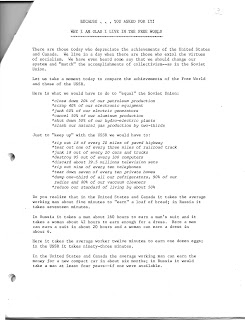


Based on this text, we should all move to Monaco (everyone's rich there, aren't they?). Ooops! I forgot, I can't afford to move there right at the moment. I must have just been born in the wrong country.

~ Meg